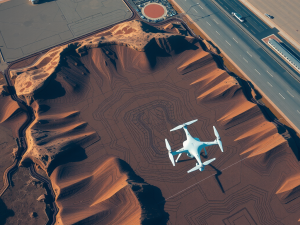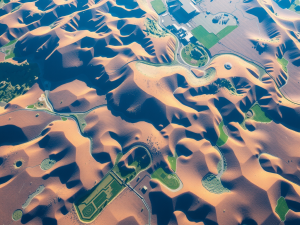

Transformative technology enables industries to enhance their capabilities in capturing and analyzing spatial data. Equipped with sophisticated sensors, these flying machines facilitate aerial photography and generate accurate maps with remarkable speed.
The use of Lidar technology not only improves measurement precision but also simplifies the assessment of topographic features and their evolution over time.
This innovative approach to surveying significantly decreases both time and financial investment when compared to traditional methods.
With increasing adoption across various fields, the array of possible applications for drone surveys keeps broadening, supporting thorough environmental evaluations and improving response strategies for natural disasters.
Revolutionizing Mapping With Drones
Technological innovation is transforming industries, including the one focused on terrain mapping. These remarkable vehicles provide unparalleled efficiency and precision in data acquisition.
The incorporation of advanced sensors brings forth high-resolution imagery that was once difficult to obtain.
Capability to survey expansive areas swiftly alters the methods used to collect geographic information.
Utilizing sophisticated software for real-time processing ensures the data gathered is not only comprehensive but also dependable. This transformation is paving the way for innovative uses in 3D modeling and geographic information systems, creating possibilities previously unimagined.

The Importance Of Accuracy In Uav Surveys
Precision plays a pivotal role in the outcomes of UAV surveys, influencing the quality of insights derived from them. Reliable data collection enhances the efficacy of techniques such as multispectral imaging, ensuring that information gathered can be transformed into actionable knowledge.
Environmental factors, like weather conditions and terrain type, significantly impact measurement reliability.
Each survey must account for elements such as light availability and altitude to prevent misinterpretations of the geographic data collected.
High-quality sensors and meticulous calibration contribute to more accurate representations of the landscape. Integrating strategic flight planning with systematic data collection practices allows professionals to bolster the quality of information generated, leading to improved management of projects in fields like construction and urban planning.
UAV Surveys
- Precision in UAV surveys directly affects the quality of insights and data interpretation.
- Environmental factors such as weather and terrain are crucial for ensuring reliable data collection.
- High-quality sensors and careful calibration are essential for accurate landscape representations.
- Strategic flight planning enhances the effectiveness of data collection in various industries, including construction and urban planning.
Exploring Terrain With Unmanned Aerial Vehicles
Technological advancements have revolutionized methods for surveying intricate landscapes. Equipped with sophisticated imaging systems, drones capture high-resolution data, enabling surveyors to gain detailed insights.
These drone surveys enhance mapping accuracy and facilitate the creation of 3D models that effectively reveal topographic features.
The capacity to access difficult terrains without endangering human presence renders UAVs an indispensable resource for terrain exploration.
Employing these aerial vehicles significantly streamlines survey times, fostering more effective workflows across various sectors.
Innovative Applications Of Aerial Photography
Transforming the landscape of various industries, aerial photography offers fresh insights and valuable data. Utilizing advanced drone technology, real estate professionals can present properties through stunning visuals and immersive virtual tours.
In the realm of agriculture, these unmanned aerial vehicles enable farmers to monitor their crops and optimize yields through detailed surveying and mapping.
Environmental specialists are leveraging aerial imagery to observe wildlife habitats and assess land use changes more effectively.
Construction projects significantly benefit from precise land surveying techniques, allowing teams to ensure adherence to regulations while monitoring project progress efficiently. The incorporation of these innovative practices is reshaping the standards within multiple fields.
Aerial Photography
- Drone technology allows for high-resolution imagery, enhancing property presentations in real estate.
- Aerial surveys can increase crop yield by up to 15% by providing farmers with critical data on plant health.
- Environmental monitoring through aerial imagery helps track wildlife populations and habitat changes effectively.
- Construction projects can reduce costs by up to 30% with accurate land surveying and project monitoring.
Enhancing Survey Data Collection Using Drones
With an increasing focus on accuracy in data gathering, innovative technologies are changing the landscape of surveying practices. Survey drones are capable of capturing high-resolution images and detailed information, which proves invaluable across diverse fields.
Traditional surveying methods often involve substantial manpower and lengthy processes.
Drone mapping significantly streamlines this workflow, allowing professionals to complete projects more efficiently.
Utilizing UAV surveying techniques, surveyors can easily navigate and gather information from challenging terrains. The application of advanced mapping software further enhances the evaluation of drone survey data, leading to a richer understanding of the inspected areas.
This transformative method is redefining how experts carry out topographic surveys.
The Role Of Lidar In Modern Surveying
The introduction of advanced technology has revolutionized the field of surveying. Utilizing laser light, this cutting-edge tool captures distances with unmatched accuracy, allowing for the generation of highly detailed topographic maps.
As traditional methods adapt, incorporating drone surveys provides a significant boost to the reliability of data collection.
These aerial mapping techniques can penetrate thick canopies, unveiling ground features that conventional methods might miss.
The integration of Lidar with UAV mapping not only streamlines data collection but also enhances the overall quality of surveying solutions, paving the way for more effective land management and planning.
Benefits Of 3D Modeling In Survey Projects
Survey projects have evolved significantly, thanks to advancements in technology that enhance efficiency and precision. The implementation of three-dimensional models allows for detailed visualizations, which play a pivotal role in presenting surveyed terrain.
These sophisticated representations foster a better understanding of site features, thereby improving stakeholder engagement.
The accuracy of drone surveying minimizes human error in data interpretation, leading to faster decision-making processes.
Consequently, this accelerates the project timeline. With the advent of drone technology, high-resolution imagery is generated, reinforcing the quality of data collected during surveying operations and highlighting its wide range of applications.
Understanding Uav Technology For Effective Surveying
The integration of aerial technology is revolutionizing the surveying industry by providing unprecedented levels of efficiency and precision. This innovative approach allows for the rapid collection of data over extensive areas, facilitating detailed analysis beyond the capabilities of conventional techniques.
Incorporating advanced 3D mapping software enables professionals to produce accurate models, greatly enhancing the decision-making process.
The flexibility of various drone types opens up a multitude of surveying applications, ranging from construction projects to agricultural monitoring.
As drone operators hone their skills, they continue to broaden the implementation of this technology, addressing diverse surveying needs with increasing effectiveness. Familiarity with these advancements equips professionals to maximize their potential.
| Advantages of Aerial Technology | Traditional Surveying Methods |
|---|---|
| Rapid data collection over large areas | Time-consuming data gathering |
| High precision with advanced 3D mapping | Limited accuracy in data representation |
| Diverse applications in various industries | Restricted to specific surveying tasks |
| Continuous skill development among operators | Static skill set in traditional methods |