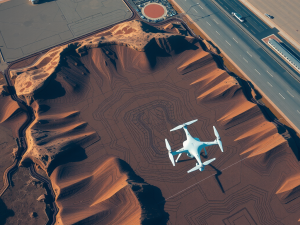

The advent of unmanned aerial vehicles has fundamentally changed the approach to gathering geographical information across various sectors. Utilizing sophisticated platforms for data collection allows for detailed visual insights that were previously difficult to obtain.
Aerial imagery captured by these devices enables precise mapping and analysis, surpassing the capabilities of classical survey methods which often demand considerable time and labor.
The implementation of Lidar technology, capable of penetrating dense foliage and assessing topographical features, has opened new avenues for exploration in challenging terrains.
This capability is particularly beneficial for industries such as agriculture and construction, where ongoing monitoring and rapid assessments are essential for effective project management. Many users may be surprised to learn that aerial platforms can enhance accuracy while simultaneously reducing costs associated with land surveying endeavors.
With a growing need for innovative data solutions, localized services are increasingly catering to unique project specifications.
Click here to learn more about: contact
Understanding Aerial Mapping Benefits
The utilization of aerial technology in mapping has brought about a significant shift in surveying capabilities. By employing drones, professionals can engage in efficient data collection, capturing high-resolution images much faster than traditional methods allow.
Equipped with advanced sensors like Lidar and multispectral cameras, aerial vehicles enhance accuracy in measurement tasks.
For construction projects, these tools prove invaluable, as they can rapidly cover expansive landscapes, allowing for thorough analysis of land features.
A less recognized advantage is the potential for reduced environmental disruption; drones minimize the necessity for extensive ground surveys, helping to safeguard natural areas while acquiring vital information. Harnessing Global Positioning System technology ensures high precision in geolocation, contributing to improved planning and resource allocation across various applications.

How Drones Revolutionize Data Collection
Recent advancements in unmanned aerial vehicle technology have transformed the methods used for collecting information across various fields. These devices enable high-resolution aerial imaging, which makes it possible to gather data with an efficiency previously unattainable.
Interestingly, one unique aspect of these tools is their capability to function in environments where traditional collection techniques fall short, such as dense forests or during inclement weather.
This ability not only broadens the scope of data acquisition but also facilitates instantaneous data analysis.
For instance, in the realm of agriculture, specialized services utilize aerial mapping to assess crop health through multispectral imaging, providing insights that can substantially increase productivity. The incorporation of LiDAR technology alongside drone usage further enhances the precision of topographical surveys, proving especially beneficial in sectors like construction and environmental assessments.
As technology progresses, the influence of drones on effective data gathering is anticipated to deepen, underscoring their role in advancing the capabilities of modern surveys.
Unmanned Aerial Vehicle Technology
- High-resolution aerial imaging allows for efficient data collection that was previously unattainable.
- Drones can operate in challenging environments, such as dense forests and adverse weather conditions.
- Aerial mapping using multispectral imaging provides valuable insights into crop health, enhancing agricultural productivity.
- LiDAR technology integrated with drones improves the accuracy of topographical surveys in construction and environmental assessments.
The Role Of Lidar In Modern Surveys
Recent advancements in surveying technology have introduced innovative methods for capturing data, transforming traditional practices. Employing drone technology allows for extensive data collection that often exceeds the capabilities of conventional techniques.
This method operates by sending out laser beams to gauge distances, which culminates in the creation of highly precise topographic maps.
Remarkably, Lidar can see through dense foliage, unveiling hidden terrain features—an invaluable asset in heavily forested regions where standard surveying encounters limitations.
Within the realm of infrastructure planning, Lidar plays a significant role.
Survey services leverage this technology to evaluate current landscapes and predict the effects of impending constructions. The speed at which Lidar can process data enables the delivery of detailed contour maps much quicker than traditional methodologies.
The synergy between Lidar and GIS technologies further enhances spatial analysis, providing rich data that supports environmental monitoring and effective land management.
Efficient Land Surveying Solutions
Advances in technology have transformed the methods employed in the field of land measurement. Innovative solutions are vital for professionals aiming to improve data collection techniques and ensure accurate results.
A prominent development is the application of UAVs, which excel in capturing high-resolution data from challenging terrains, greatly enhancing the quality of topographic survey results.
The time efficiency of drone data collection is remarkable; it can reduce project timelines by up to 75% compared to traditional approaches.
When paired with Lidar sensors, UAVs facilitate intricate three-dimensional mapping, resulting in detailed point clouds that empower informed decision-making. These improvements significantly impact sectors like construction and environmental monitoring, leading to better operational efficiency and reduced costs.
Exploring Smartdrone Technology
Advanced developments in aerial technology are redefining the approach to surveying and mapping, pushing the boundaries of traditional methodologies. Unlike their conventional counterparts, systems utilizing lidar technology and other sophisticated sensors deliver unparalleled accuracy during aerial surveys.
For instance, these professional drone services can generate survey-grade outputs that result in highly precise topographical maps.
Such detailed measurements are vital not only in construction projects but also for environmental monitoring, where data integrity directly influences critical decision-making processes.
Through the real-time analysis of collected data, drone pilots can efficiently assess site usage, providing insights that significantly enhance project delivery. The adoption of these innovative technologies leads to a remarkable reduction in the duration required for site evaluations, creating unmatched efficiencies.
As various sectors increasingly incorporate these advancements, the wide-ranging benefits of drone mapping services are anticipated to broaden, unlocking new utilization opportunities across multiple industries.
Accurate Measurements With Drone Services
Recent advancements in technology have revolutionized measurement methods across various industries. Drones equipped with high-resolution sensors are capable of capturing intricate imagery, which significantly enhances data analysis precision.
For example, Lidar services are particularly advantageous in environments that are dense, facilitating detailed topographical mapping where traditional approaches often falter.
Aerial surveys can cover extensive areas swiftly, notably decreasing the time it takes to gather data compared to conventional ground-based techniques.
This time efficiency is important for urban planning, where up-to-date information is essential for informed development decisions. The integration of aerial data with GIS technologies provides comprehensive insights for stakeholders involved in projects.
The latest drone technology ensures that data collection remains both rapid and reliable, supporting a diverse array of applications from construction to environmental monitoring.
Measurement Advancements
- Drones with high-resolution sensors enhance data analysis precision.
- Lidar technology excels in dense environments for detailed topographical mapping.
- Aerial surveys significantly reduce data collection time compared to ground-based methods.
- Integration of aerial data with GIS technologies offers comprehensive insights for project stakeholders.
Enhancing Construction Projects With Aerial Surveys
The implementation of advanced data collection techniques is transforming construction project management. Utilizing modern technology, aerial surveys capture high-resolution imagery and facilitate efficient data acquisition.
Drones equipped with drone lidar technology generate precise topographical maps, revealing intricate details often overlooked by manual surveys.
Access to remote locations allows for comprehensive assessments of sites previously deemed difficult to evaluate.
Aerial survey services can significantly expedite project timelines and reduce overhead costs, appealing to clients in construction. The integration of Geographic Information Systems (GIS) with aerial data enhances spatial analysis, allowing professionals to make informed decisions.
Many professionals benefit from these comprehensive drone survey solutions, which provide the accurate data vital for project success. Our team of insured drone pilots utilizes advanced drone lidar technology and comprehensive drone survey solutions to provide clients in construction with accurate aerial data essential for their projects.
Get Your Free Quote For Aerial Services
Utilizing innovative technologies in the field of aerial surveying can profoundly influence project success. By employing survey-grade equipment, you capture data with remarkable precision that traditional methods may overlook.
Techniques such as light detection and ranging (LiDAR) create intricate 3D representations of the surface of the earth, providing invaluable insights for various applications.
This advanced approach allows for comprehensive mapping in a fraction of the time needed compared to conventional processes, thereby minimizing disruption and enhancing productivity.
When considering new projects, obtaining a free quote allows you to align your requirements with the specific services offered by local providers. These specialists possess the expertise to customize their data collection methods to cater to the needs of our clients, ensuring the highest quality results.
To further understand how aerial services can benefit your initiatives, contact us today for a detailed assessment.
| Technology | Benefits |
|---|---|
| LiDAR | Creates intricate 3D representations of the earth’s surface |
| Survey-grade equipment | Captures data with remarkable precision |
| Advanced mapping techniques | Minimizes disruption and enhances productivity |
| Customized data collection | Ensures highest quality results tailored to client needs |