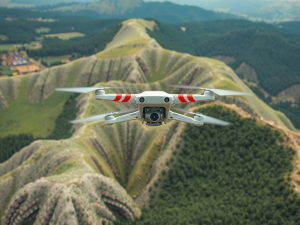

Recent advancements in technology have revolutionized the collection and analysis of geographical data, significantly enhancing the capabilities of survey methods. Aerial surveys utilizing unmanned aerial vehicles can cover extensive landscapes while producing detailed datasets in a remarkably short timeframe.
Equipped with sophisticated sensors, including Lidar and multispectral cameras, these devices generate high-resolution imagery that uncovers nuanced features of the terrain.
This technology plays a critical role across various sectors, particularly in agriculture, where accurate topographical information can optimize planting and irrigation decisions.
The ability of drones to access challenging locations reduces risks often associated with traditional data collection methods. Case studies illustrate how the combination of UAV data with Geographic Information Systems (GIS) can provide deeper insights into resource management and site planning.
As drone capabilities continue to advance, the potential for practical applications in aerial mapping is expected to expand, offering new solutions for industries such as construction and environmental monitoring.
Click here to learn more about: contact
Exploring The Benefits Of Drone Mapping
Advancements in aerial technology are reshaping the landscape of geographical data collection and analysis. Utilizing Unmanned Aerial Vehicles (UAVs), professionals can achieve remarkable accuracy in information gathering through cutting-edge sensor systems.
For example, Lidar technology can penetrate dense vegetation, facilitating precise terrain mapping that traditional ground-based surveys often cannot provide.
This attribute is especially significant in industries such as mining and construction, where obtaining exact topographical data plays a pivotal role in project planning and execution.
Drones are capable of conducting flight missions across expansive regions in a fraction of the time required by conventional surveying methods. Remarkably, certain projects employing these techniques have demonstrated the potential to reduce surveying durations by as much as 75%, thereby accelerating the overall decision-making process.
Notably, California has experienced a surge in the use of these technologies, highlighting their versatility in applications ranging from urban planning to environmental monitoring.

Case Studies In Aerial Surveying Techniques
Innovations in remote exploration have significantly reshaped various industries’ approaches to mapping and data acquisition. A compelling case study highlights how drones fitted with advanced sensors managed to decrease survey durations by more than 75% within construction environments.
These vehicles excel in producing detailed orthophoto maps, enabling precise monitoring of project development.
In environmental examination, aerial mapping techniques have become crucial for recording changes in terrain, particularly in regions suffering from deforestation.
Drones offer the advantage of accessing challenging landscapes, thereby reducing the dangers tied to conventional ground surveys. The amalgamation of diverse sensor technologies has led to substantial enhancements in data accuracy.
For example, the integration of Lidar with photogrammetry significantly amplifies the depth and clarity of the collected information. These developments exemplify the swift advancement of aerial techniques and their essential contributions across multiple sectors.
Remote Exploration Innovations
- Drones can reduce survey durations by over 75% in construction environments.
- Aerial mapping techniques are essential for monitoring terrain changes, especially in deforested areas.
- Drones enhance safety by accessing difficult landscapes, minimizing risks associated with ground surveys.
- The combination of Lidar and photogrammetry improves data depth and clarity significantly.
Understanding The Role Of UAVs In Data Collection
Unmanned aerial vehicles have revolutionized the processes involved in collecting and analyzing data across various sectors. The shift from conventional methods to advanced techniques has led to substantial improvements in efficiency and accuracy.
These aircraft can deploy specialized sensors, including Lidar and multispectral imaging, which facilitate the gathering of diverse datasets essential for industries such as agriculture, construction, and environmental monitoring.
For instance, terrain inspections that were once difficult or impossible are now easily conducted using drone technology.
A lesser-known aspect is that aerial mapping not only captures physical land features but also provides insights into vegetation health and land use patterns that ground surveys may overlook. The synergy between drone data and geographic information systems enhances spatial analysis, yielding comprehensive insights that empower decision-makers across multiple domains.
This advancement not only streamlines the surveying process but also significantly reduces operational expenditures.
A Deep Dive Into Lidar Applications
Utilizing advanced technology for precise mapping has transformed numerous industries, particularly through laser-based methods that measure distances and generate intricate three-dimensional models of the Earth’s surface. This process involves emitting light pulses and gauging the duration it takes for them to return, resulting in high-density point clouds.
Aerial surveys by a drone enable comprehensive coverage of expansive areas in a short timeframe, proving especially beneficial for mapping dense forests where other techniques face limitations.
Unlike conventional methods, this technology can penetrate vegetation, exposing the underlying terrain.
Such capabilities are significant for applications spanning environmental monitoring and urban development. The combination of unmanned aerial vehicles (UAVs) with advanced data collection methods not only optimizes efficiency but also yields precise topographic maps essential for effective site management.
As one of the largest innovations in aerial surveying, this technology streamlines operations and enhances productivity across various sectors.
| Technology | Benefits |
|---|---|
| Laser-based mapping | Generates intricate three-dimensional models |
| Aerial surveys by drones | Comprehensive coverage of large areas quickly |
| Vegetation penetration | Reveals underlying terrain for accurate mapping |
| Combination of UAVs and data collection | Optimizes efficiency and produces precise topographic maps |
Accuracy And Precision In Aerial Mapping
Aerial mapping relies heavily on the precise measurement of geographic data, a factor that significantly influences project outcomes across various sectors. Accuracy is defined as how closely a set of measurements aligns with the true value, while precision reflects the consistency of those measurements when repeated.
Modern UAV mapping techniques employ advanced sensors and cameras to produce detailed maps, often achieving precision within a few centimeters.
Technologies such as Lidar play a crucial role in enhancing data quality, particularly as the complexity of projects increases.
Drones capable of performing topographic surveys have revolutionized traditional methods, providing new capabilities for data collection that can lead to substantial cost savings. Depending on project specifics, aerial services may range from hundreds to thousands of pounds, making it essential to tailor solutions to meet unique requirements.
Thoughtful flight planning and execution are vital for improving the reliability of the data gathered. Those interested in personalized aerial solutions today at 01642 can explore the various options available to meet their mapping needs.
The Future Of Fixed Wing Aircraft In Surveys
Aerial technology is experiencing a transformative phase, particularly with the widespread use of fixed wing models in various survey applications. Equipped with advanced lidar systems, these aircraft can efficiently collect high-resolution imagery and accurate data, which are crucial for producing intricate 3D maps.
This innovative approach allows for extensive coverage and long-duration flights, making it particularly effective in sectors such as agriculture, urban planning, and environmental monitoring.
In challenging terrains, fixed wing aircraft demonstrate reliability by gathering valuable insights, even in remote areas.
For instance, they are instrumental in assessing vegetation health and evaluating regions impacted by forest fires, showcasing their versatility in diverse environments. As the appetite for precise aerial mapping grows, the prospects for these aircraft in surveying seem bright, fueled by relentless advancements in technology and their increasing significance in strategic planning across multiple industries.
Aerial Technology
- Fixed wing models equipped with advanced lidar systems can collect high-resolution imagery and accurate data.
- These aircraft are effective in various sectors, including agriculture, urban planning, and environmental monitoring.
- They demonstrate reliability in challenging terrains, providing insights even in remote areas.
- The demand for precise aerial mapping is increasing, highlighting the growing significance of these technologies in strategic planning.
Innovative Solutions For Mining Surveys
Recent advancements in technology have led to significant improvements in surveying processes, particularly in the mining sector. The use of unmanned aerial vehicles (UAVs) enables extensive data collection that offers unique insights into topography and resource distribution.
Remarkably, these aircraft can cover vast expanses during a single flight, drastically minimizing the time required for field surveys.
Many companies are turning to sophisticated imaging solutions, including Lidar and photogrammetry, processed to create detailed maps and accurate 3D models.
Such innovations facilitate the precise identification of mineral locations, thereby streamlining the exploration phase. Employing UAVs enhances safety by reducing the necessity for personnel to access hazardous areas.
As airspace regulations adapt to accommodate these technological advancements, ensuring compliance becomes crucial for effective deployment. Professionals looking to discover innovative solutions can find that integrating such technology not only lowers operational costs but also leads to improved project efficiency.
The next evolution in surveying practices can be explored further with the advantages offered by the WingtraOne system, which maximizes efficiency in aerial data collection.
Maximizing Efficiency With WingtraOne Technology
Advanced unmanned aircraft technology transforms the approach to aerial surveys, enabling the rapid collection of extensive data in high resolution. This capability is particularly advantageous for various industries, including agriculture and construction, where quick and reliable data acquisition is paramount.
The device employs photogrammetry techniques, which facilitate accurate topographic mapping and detailed spatial analysis.
A standout feature is its vertical take-off and landing (VTOL) system, making it suitable for deployment in diverse environments, including woodland areas or locations near powerlines.
Enhanced by sophisticated sensors, the quality of data captured provides insights often missed by traditional surveying approaches. The information gathered can be effortlessly integrated and stored within GIS platforms for thorough analysis, thereby allowing organizations to optimize their operational efficiency.
The innovative design and functionality of this technology position it as a leader in UAV mapping solutions, fundamentally supporting modern surveying practices.
Advanced Unmanned Aircraft Technology
- Enables rapid collection of extensive high-resolution data
- Employs photogrammetry techniques for accurate topographic mapping
- Features vertical take-off and landing (VTOL) system for diverse deployment
- Data can be integrated into GIS platforms for thorough analysis
Aerial Survey Cost Analysis Drone Savings Unveiled
Aerial Survey Industry Standards Insightful Data Survey