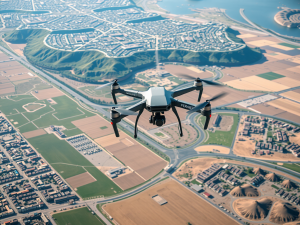

Recent advancements in technology have enabled the mining sector to utilize aerial systems for inspections, significantly enhancing operational performance. Employing unmanned aerial vehicles allows for precise data collection and mapping, ensuring thorough assessments even in challenging environments.
The ability of these systems to survey hard-to-reach locations provides comprehensive insights that traditional ground methods often miss, particularly in extensive mining sites where diverse terrain complicates access.
Real-time data acquisition techniques, such as photogrammetry, facilitate the production of detailed topographic maps essential for effective spatial analysis.
These maps play a vital role in improving operational workflows while minimizing the time required to collect critical information. The swift and detailed insights generated through aerial surveys contribute to safer, more efficient practices within the mining industry.
As technology continues to advance, the integration of drone solutions in inspections is poised to become increasingly prevalent, revolutionizing how mining operations are conducted.
Click here to learn more about: contact
Click here to learn more about: contact
Click here to learn more about: contact
Click here to learn more about: contact
Revolutionizing Mining Inspections With Drones
The use of unmanned aerial vehicles has fundamentally transformed the methodologies employed for inspections within the mining sector. Traditional practices often encounter barriers related to personnel safety and accessibility to remote areas.
The deployment of drone technology addresses these issues effectively.
Capable of navigating difficult terrains, drones facilitate prompt and precise data collection.
With advanced sensors onboard, these aerial devices conduct thermal imaging, uncovering geological anomalies that might otherwise evade detection during standard inspections. This advance not only promotes operational efficiency but also enhances risk management by pinpointing potential hazards at early stages.
The synergy between aerial data and Geographic Information Systems (GIS) fosters sophisticated spatial analysis, ultimately supporting improved decision-making in resource management.

Enhancing Data Accuracy Through Aerial Surveys
The advent of drone technology has reshaped the landscape of geographical data collection, providing unprecedented levels of precision and efficiency. Utilizing advanced techniques like Lidar and photogrammetry, these aerial methods yield more accurate information than conventional practices.
Drones equipped with high-resolution cameras can meticulously capture images and data, which are subsequently synthesized into intricate maps and models.
A lesser-known fact is that, beyond their recreational applications, drones play a vital role in sectors such as mining and construction, where they facilitate accurate topographic mapping and detailed surveys of stockpiles and tailings.
Their ability to traverse rugged or inaccessible terrain drastically cuts down the time and costs associated with traditional data gathering techniques. The integration of aerial photography enhances the visualization of data, enabling stakeholders to make informed decisions based on comprehensive insights.
This synergy of speed and detail underscores the importance of aerial surveys in a variety of industries, enhancing project outcomes while optimizing resource management.
- Drones provide higher precision and efficiency in geographical data collection compared to traditional methods.
- Advanced techniques like Lidar and photogrammetry are employed to create detailed maps and models.
- Drones significantly reduce the time and costs associated with data gathering in rugged or inaccessible areas.
- Aerial photography enhances data visualization, aiding stakeholders in making informed decisions.
The Benefits Of 3D Modeling In Mining
The integration of advanced visualization techniques has transformed operational practices within the extraction sector. This technology allows mining companies to represent geological formations with remarkable fidelity, significantly enhancing their understanding of spatial dynamics.
Unique Fact: 3D models are capable of simulating various mining scenarios, facilitating proactive planning and risk assessment by enabling the analysis of potential obstacles before they manifest.
Incorporating geological data into these models can decrease estimation errors by up to 30%, which leads to improved decision-making and optimizes mining operations.
These visualizations serve as powerful communication tools, fostering transparency with stakeholders and regulatory agencies, thereby supporting compliance with environmental regulations. Projects utilizing this innovative technology often report a reduction in time spent on preliminary assessments by as much as 25%, underscoring its significant impact on operational efficiency.
Optimizing Stockpile Management Using Drones
The use of unmanned aerial vehicles offers transformative potential in managing stockpiles within mining operations. Their ability to execute aerial surveys enables the collection of substantial data while refining inventory oversight.
With advancements in drone mapping for mining applications, companies achieve accuracy levels previously unattainable.
For instance, drones can create intricate 3D models of stockpiles through high-resolution imagery, facilitating precise volume calculations.
Traditional methods often lack the efficiency and precision required, underscoring the superiority of drone solutions for mining. Drones can traverse rugged landscapes that impede ground-based survey teams, significantly reducing disruptions at mining sites.
This technological advancement accelerates data collection processes while enhancing the reliability of gathered information, thereby influencing strategic resource allocation decisions.
The benefits of incorporating UAV technology extend beyond mere data collection. By utilizing innovative drone mining survey techniques, companies can streamline their operations, making real-time adjustments based on accurate data analysis.
Enhanced data visualization capabilities introduce new dimensions to inventory management systems, allowing for better tracking and forecasting.
As mining sites often involve complex logistical challenges, drone programs can effectively mitigate these issues by providing an aerial perspective that informs operational strategies.
Transitioning from the efficiencies gained through drone data collection leads to a deeper exploration of other technologies enhancing mining operations. One such technology is Lidar, which has revolutionized drone mapping for mining by providing precise data collection and optimization solutions that enhance traditional methods of mining exploration and ore extraction.
| Advantage of UAV Technology | Traditional Methods |
|---|---|
| High-resolution imagery for 3D models | Limited accuracy in volume calculations |
| Ability to traverse rugged landscapes | Ground-based surveys face disruptions |
| Real-time data analysis for operational adjustments | Slower response to inventory changes |
| Enhanced data visualization for better tracking | Less effective inventory management systems |
Understanding The Role Of Lidar In Mining Operations
Advanced technologies like remote sensing are transforming various industrial sectors, including mining. Lidar technology plays a crucial role by employing light reflection to gather comprehensive terrain data.
This innovative method uses laser pulses to gauge distances and produce high-resolution topographic maps, which are invaluable in pinpointing potential mining locations.
Originating in the 1960s, Lidar has undergone significant advancements, becoming an integral component of mining operations globally.
A standout feature of this technology is its ability to execute precise volume calculations for stockpiles, a vital aspect of resource management in mining applications.
Traditional surveying methods often involve considerable labor and time, whereas Lidar dramatically reduces the time necessary for accurate survey data collection. The generation of point clouds from Lidar data allows for the efficient analysis and processing of extensive areas, leading to improved planning and environmental assessments.
These benefits are essential for maintaining sustainable practices within the mining sector.
How Drone Technology Streamlines Data Collection
Recent advancements in aerial technology have transformed approaches to gathering and analyzing information across various sectors. Fixed-wing drones are now capable of conducting surveys at a fraction of the cost of traditional methods while delivering unparalleled accuracy.
Unlike conventional techniques, which often require significant manpower and resources, this innovative approach allows surveyors to efficiently cover expansive areas.
Equipped with sophisticated sensors, these flying devices can capture high-resolution imagery and data, even in challenging environments, thus improving inventory management capabilities.
The use of data processing software facilitates the creation of a digital twin of your mine, enabling real-time analysis and monitoring. This capability not only accelerates data acquisition but also ensures the information is consistently up-to-date, which supports informed decision-making in numerous industries.
| Advancements in Aerial Technology | Traditional Methods |
|---|---|
| Cost-effective surveys | Higher operational costs |
| High-resolution imagery | Lower quality data |
| Efficient coverage of large areas | Significant manpower required |
| Real-time analysis and monitoring | Delayed data processing |
Exploring The Cost Efficiency Of Drone Solutions
Innovative technologies are reshaping how industries gather and utilize critical data for operational needs. Aerial surveying with unmanned aerial vehicles can provide comprehensive data at significantly lower costs compared to conventional methods.
For example, high-precision digital terrain models (DTMs) generated by drones deliver accurate results much faster than traditional equipment would allow.
This acceleration in project timelines proves advantageous in sectors such as mining and quarry operations, where time translates into cost savings.
The capability to reach remote work sites and navigate difficult terrain empowers project managers to make informed decisions promptly. Studies indicate that transitioning to drone technologies can yield reductions in labor and equipment costs by up to 30%.
As drone technology matures, the potential for enhanced 2D and 3D modeling will further improve data collection efficiency, making it an essential tool for site managers across various applications.
Achieving Precision With Photogrammetry In Mining
Innovative methodologies have emerged to transform practices within the mining sector, particularly through the implementation of aerial data collection systems. Employing cutting-edge sensors, these operations can achieve accurate volume estimation and generate crucial outputs such as digital elevation models and geotagged 3D maps.
Such models streamline stockpile inventory processes, significantly impacting financial assessments and operational planning.
The enhancement of slope maps offers vital insights into site safety and stability, which are essential in maintaining operational integrity.
This technology is particularly effective in underground operations, where traditional surveying methods often struggle due to limited accessibility. Compared to standard practices, the application of photogrammetry increases overall efficiency and produces precise data within a considerably reduced timeframe.
The ongoing integration of these advanced technologies is expected to propel further innovations in resource management and operational effectiveness as mining continues on its digital transformation journey.
Innovative Methodologies in Mining
- Aerial data collection systems utilize advanced sensors for accurate volume estimation.
- Digital elevation models and geotagged 3D maps enhance stockpile inventory processes.
- Improved slope maps provide essential insights for site safety and stability.
- Photogrammetry significantly increases efficiency and data precision in underground operations.
Real Estate Aerial Photography Services Transform Listings With Unique Drone Views
Infrastructure Inspection UAV Elevating Drone Inspections For Vital Structures
Uav Survey Near Me Drone Mapping Magic
UAV Surveying Applications Map Magic
UAV Surveying Techniques Elevate Drone Mapping
Drone Surveying Techniques Fast Land Mapping Secrets
UAV Surveying Techniques Elevate Drone Mapping